

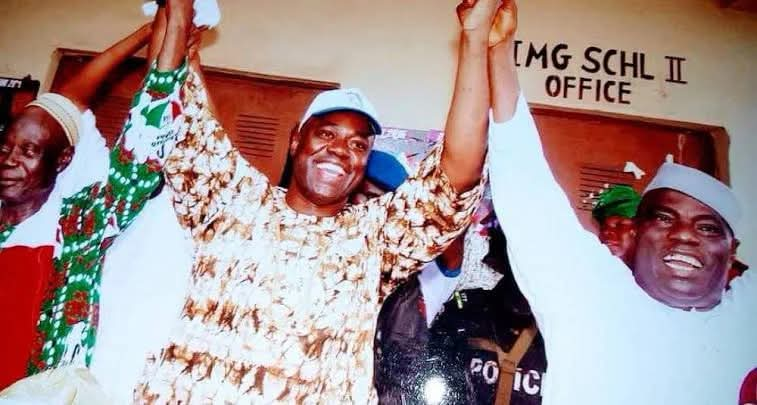
The political disagreement between Governor Seyi Makinde of Oyo State and veteran politician, Alhaji Adebisi Olopoeyan, has exposed deep-seated tensions over party ownership, political loyalty, leadership influence and the control of grassroots structures in the state.
The political relationship between Governor Seyi Makinde of Oyo State and a prominent Ibadan politician, Alhaji Adebisi Olopoeyan, appears to have reached another difficult phase, with the crisis surrounding the Allied Peoples Movement (APM) exposing competing interests within the state’s political landscape.
At the centre of the disagreement is Olopoeyan’s allegation that Makinde and his political associates are attempting to take control of the APM structure, which he claims was painstakingly built by him and other party loyalists before the governor’s political allies joined the platform.
Beyond the immediate disagreement over the party’s leadership and the distribution of electoral tickets, the controversy raises fundamental questions about political ownership, the place of party founding members and the extent to which established political structures should accommodate influential newcomers.
To understand the roots of the disagreement, it is important to examine Olopoeyan’s political background, his relationship with Makinde and the events that have brought both men into another political confrontation.
Olopoeyan’s political background
Olopoeyan is a veteran Ibadan politician whose political career spans several decades. He is widely associated with grassroots mobilisation, political organisation and his longstanding relationship with the late Chief Lamidi Ariyibi Adedibu, one of the most influential political figures in Oyo State’s political history.
His political journey dates back to the era of the defunct National Party of Nigeria (NPN), before the military coup of December 1983 brought the Second Republic to an abrupt end.
With the return of democratic governance in 1999, he became involved in the Peoples Democratic Party (PDP) and was introduced to Adedibu around 2000. That relationship subsequently became an important turning point in his political career.
Adedibu’s political machinery was renowned for its grassroots mobilisation, extensive network and ability to influence electoral outcomes, particularly in Ibadan and other parts of Oyo State.
Operating within that political environment, Olopoeyan developed relationships with influential politicians and built a network of supporters that strengthened his relevance in the state’s political calculations.
His political engagements also brought him into the camps of former Governor Adebayo Alao-Akala and, subsequently, Makinde.
Over the years, he has operated within different political platforms, including the PDP, New Nigeria Peoples Party (NNPP) and, more recently, the APM.
For Olopoeyan, political participation has seemingly extended beyond party membership to include influence over party administration, candidate selection and the recognition of those who invested in building the organisation.
How Makinde and Olopoeyan fell apart
One of the most consequential chapters of Olopoeyan’s political career was his involvement in Makinde’s emergence as governor in 2019.
Before the governorship election, Olopoeyan was among the political actors who reportedly helped introduce Makinde to established political stakeholders and mobilise support for his ambition.
Olopoeyan had, on several occasions, recalled his efforts to reconcile aggrieved stakeholders following the PDP governorship primary and consolidate political support around Makinde.
He maintained that Makinde’s eventual electoral victory was not achieved in isolation, arguing that the contributions of established politicians, grassroots mobilisers and party stakeholders were significant to the outcome.
However, the relationship reportedly deteriorated after Makinde assumed office.
Olopoeyan publicly expressed dissatisfaction with what he perceived as the governor’s growing distance from some of the political figures who supported his emergence.
He also challenged Makinde’s position on political godfatherism, insisting that those who contributed to a politician’s electoral success deserved consultation, recognition and continued engagement.
The disagreement eventually resulted in Olopoeyan’s departure from the PDP for the NNPP, where he became a prominent political figure in the Southwest.
In 2021, he was openly critical of Makinde’s political leadership and questioned the governor’s prospects of securing a second term.
However, the political differences appeared to have subsided following Makinde’s re-election victory in 2023.
On March 20, 2023, Olopoeyan visited the governor, with the meeting publicly reported as a reconciliation effort. He subsequently described their disagreement as a misunderstanding that had been resolved, expressing optimism about working together for the development of Oyo State.
The renewed disagreement over the APM, however, suggests that the underlying political differences may not have been completely resolved.
Why the APM has become the centre of the crisis
The latest disagreement revolves around the management of the APM, particularly its leadership structure, candidate selection process and the political interests of those who established the party’s presence in Oyo State.
The crisis reportedly intensified in August 2026 following disagreements over the selection of candidates for the forthcoming local government elections.
Olopoeyan’s camp reportedly felt that longstanding APM members and loyalists who had invested in building the party were being marginalised in the distribution of chairmanship tickets and other political opportunities.
The arrival of Makinde’s political associates into the party’s political arrangement reportedly heightened tensions over the control of its existing structures.
Three fundamental issues appear to define the disagreement.
Who built the APM structure in Oyo State?
Olopoeyan’s camp maintains that it invested considerable political resources, time and energy in establishing the APM’s organisational structures across the state before the arrival of Makinde’s political allies.
The camp argues that the party’s existing members had already established leadership arrangements and secured positions within its executive structures before the new political alliance emerged.
Consequently, they believe that their contributions should be recognised and that they should retain meaningful influence in the administration of the party.
The disagreement, therefore, goes beyond the question of political affiliation to the broader issue of whether those who established a party’s structures should retain a significant voice in determining its future.
Is Makinde seeking to take control of the APM?
This is perhaps the most contentious allegation coming from Olopoeyan’s camp.
The camp believes that Makinde and his political associates are attempting to assume control of the party’s leadership and decision-making processes, thereby weakening the influence of its original stakeholders.
Although the governor’s political camp may have its own justification for seeking greater participation in the party, the controversy has exposed the difficulties associated with integrating an influential political bloc into an existing party structure.
At the heart of the matter is the question of how political influence should be shared between established party members and those joining the platform with considerable political strength.
Who gets the electoral tickets?
The distribution of electoral tickets has emerged as one of the immediate triggers of the crisis.
In August 2026, the disagreement over candidate selection reportedly resulted in legal action involving 384 APM candidates, comprising 33 chairmanship candidates and 351 councillorship candidates, who approached the Federal High Court in Ibadan.
The candidates challenged reported moves to conduct fresh primaries for the local government elections, arguing that their earlier primaries had been monitored by the Oyo State Independent Electoral Commission (OYSIEC) and that their nominations should not be displaced by competing groups.
The development elevated the disagreement from an internal political misunderstanding to a legal contest involving the legitimacy of party primaries, candidate nominations and the interpretation of relevant electoral procedures.
The eventual judicial determination is expected to have significant implications for the competing interests within the party.
Olopoeyan’s next political move
Amid the lingering crisis, Olopoeyan has reaffirmed his commitment to the APM, insisting that he and his supporters have no immediate intention of abandoning the party.
In a recent political engagement, he hosted 24 members of the party’s 30-member state executive committee alongside chairmen from 32 of the state’s 33 local government areas.
The meeting was seen as an indication of his determination to sustain his political influence within the party and consolidate the support of those who share his position.
Olopoeyan reportedly maintained that genuine party members who contributed to building the APM deserved recognition and meaningful participation in its decision-making process.
On the disputed candidates, he indicated that the matter was already before the court and that his camp would abide by the eventual judicial pronouncement.
His position suggests that, rather than immediately seeking another political platform, he intends to pursue the struggle from within the APM.
The political implications for Makinde
The unfolding crisis presents another significant political test for Makinde, particularly as preparations gather momentum for the 2027 general elections and the forthcoming local government polls.
Although the governor remains an influential political figure in Oyo State, the disagreement highlights the challenges of managing competing interests within political alliances.
First, a prolonged disagreement could weaken the APM’s organisational cohesion and create rival centres of political authority.
Second, the litigation surrounding the disputed nominations could introduce uncertainty into the party’s preparations for the local government elections, particularly if the legal process is not concluded within the relevant electoral timetable.
Third, the crisis could affect relationships within the broader political coalition supporting Makinde’s political interests, as other stakeholders closely observe how the disagreement is resolved.
More importantly, the controversy raises questions about the confidence established party members can have in political alliances involving powerful political figures.
For Makinde, the challenge may not necessarily be the ability to attract new political allies but how to accommodate existing stakeholders without creating the impression that their previous contributions have become irrelevant.
For Olopoeyan, the battle is equally consequential. His ability to retain the support of party executives, local government structures and grassroots loyalists could determine his relevance in the unfolding political equation.
Ultimately, the APM crisis is more than a disagreement between two politicians who once worked together. It represents a broader contest over political influence, party ownership, loyalty and the distribution of power in Oyo State.
Whether both camps eventually reach a political settlement or allow the courts to determine the disputed issues, the outcome could reshape the relationship between established political structures and emerging power blocs in the state.
Source: City People