
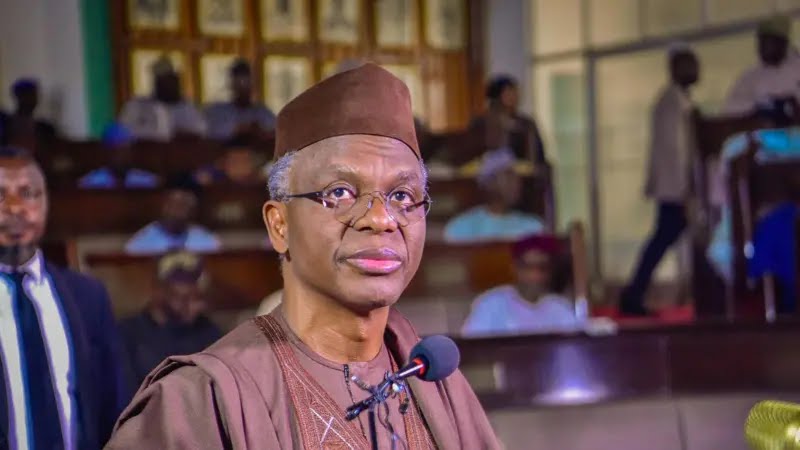
Former Governor of Kaduna State, Nasir El-Rufai, has filed a N1 billion fundamental rights enforcement suit against the Independent Corrupt Practices and Other Related Offences Commission (ICPC) and others, including a magistrate, over a recent reported raid on his Abuja residence.
The News Agency of Nigeria (NAN) reports that the suit, marked FHC/ABJ/CS/345/2026, was filed at the Federal High Court, Abuja.
In the originating motion filed on Friday (20 February) on his behalf by his lawyer, Oluwole Iyamu, a Senior Advocate of Nigeria (SAN), on Friday (20 February), Mr El-Rufai sued ICPC alongside the Chief Magistrate, Magistrate’s Court of the FCT, Abuja Magisterial District; the Inspector-General of Police and the Attorney-General of the Federation (AGF).
Mr El-Rufai asked the court to declare that the search warrant issued on 4 Febryary by the chief magistrate authorising the search of his residence at House 12, Mambilla Street, Aso Drive, Abuja, as invalid, null and void.
He contended that the warrant lacked particularity, contained material drafting errors, was ambiguous in its execution parameters, overbroad in scope, and unsupported by probable cause.
According to him, the alleged defects rendered the warrant unconstitutional and in breach of Section 37 of the Nigerian Constitution (as amended), which guarantees the right to privacy.
The ICPC, which arrested Mr El-Rufai on Wednesday’s night as he was leaving the custody of the Economic and Financial Crimes Commission (EFCC) in Abuja, raided the former governor’s house in the capital city on Thursday in connection with ongoing corruption investigations.
Muyiwa Adekeye, Mr El-Rufai’s media aide, disclosed the development in a post on X (formerly Twitter).
Both the ICPC and the EFCC shown renewed interests in Mr El-Rufai in the last few months.
Apart from the ongoing investigations by the two anti-corruption agencies, the State Security Service (SSS) also filed cybercrime charges against him last Monday (16 February) at the Federal High Court in Abuja, over the alleged unlawful interception of the phone communications of the National Security Adviser (NSA), Nuhu Ribadu.
This followed Mr El-Rufai’s claim on a live interview on Arise TV that the National Security Adviser (NSA) Nuhu Ribadu’s phone conversation was intercepted, and that he heard the NSA directing security operatives to detain him.
Mr El-Rufai said the NSA’s order was behind the alleged attempt to arrest him at the Nnamdi Azikiwe International Airport, Abuja, on 12 February.
PREMIUM TIMES earlier reported that Mr El-Rufai was involved in a heated verbal exchange with security operatives at the Abuja airport shortly after he arrived in the country.
The Federal High Court in Abuja has now fixed Wednesday (25 February) for his arraignment on the phone interception charges.
Although, the ICPC confirmed Mr El-Rufai’s arrest by its agents on 18 February, it has yet to comment on the raid on his home or release him from custody.
Mohammed Shaba, a principal secretary to the former governor who swore an affidavit filed in support of the suit, wrote that officers of the ICPC and the Nigeria Police Force searched the premises without lawful authority and seized documents and electronic devices.
He further claimed that the officers did not submit themselves for search as required by law and that the warrant failed to specify the items sought.
Mr Shaba stated that none of the seized items had been returned and that the applicant had suffered humiliation, psychological trauma and distress as a result of the operation.
Faulting the validity of the search warrant, Mr El-Rufai’s lawyers argued that the warrant in question vaguely referred to “the thing aforesaid” without clear description, contained typographical errors, and was indiscriminately addressed to “all officers.”
The counsel cited judicial authorities including C.O.P. v. Omoh (1969) NCLR 137 and Fawehinmi v. IGP (2000) 7 NWLR (Pt. 665) 481 in support of his position that evidence obtained through unlawful means is inadmissible.
He argued that it contravened Sections 143–148 of the Administration of Criminal Justice Act (ACJA), 2015, as well as Section 36 of the ICPC Act, 2000.
According to him, the action offended Section 143 which requires sworn written information establishing reasonable grounds for suspicion; Section 144 which mandates specific description of the place and items to be searched; Section 146 which requires that warrants be in prescribed form and free of defects; Section 147 which restricts execution to specified persons; and Section 148 which provides for execution at reasonable times.
The detained former governor urged the court in the suit to declare that the invasion of his residence on 19 February at about 2 p.m. by the agents of the ICPC and the police amounted to a gross violation of his fundamental rights guaranteed under the Nigerian constitution.
According to him, the action violated his right to dignity of the human person (Section 34), personal liberty (Section 35), fair hearing (Section 36); and privacy (Section 37).
He also urged the court to hold that any evidence obtained pursuant to the allegedly defective warrant is inadmissible in any proceedings against him.
Among the seven prayers, Mr El-Rufai sought an order restraining the respondents from relying on or tendering any material seized during the search in any investigation or prosecution involving him.
He also sought an order directing the ICPC and the Inspector-General of Police to immediately return all items seized from his residence with a detailed inventory.
The former governor also urged the court award of N1 billion as general, exemplary and aggravated damages in his favour. According to him, the N1 billion request comprises N300 million as compensatory damages for psychological trauma and emotional distress; N400 million as exemplary damages to deter future misconduct and N300 million as aggravated damages for alleged malicious and oppressive conduct.
He also sought N100 million as cost of filing the suit, including legal fees and associated expenses.
NAN reports that the suit comes amid ongoing investigations involving the former governor.
Mr El-Rufai was earlier arrested by EFCC over alleged financial improprieties linked to his tenure as Kaduna State governor between 2015 and 2023.
Following his arrest, he was reportedly interrogated over alleged mismanagement of public funds and contract awards during his administration.
Subsequently, the ICPC also commenced separate investigations over alleged abuse of office and procurement-related infractions.
The anti-corruption agency later took custody of the former governor in connection with the probe, and he is said to be currently in detention pending the conclusion of investigations and possible arraignment.
The filing of the fundamental rights enforcement suit is therefore seen as part of his legal response to the ongoing actions by the anti-graft agencies.