

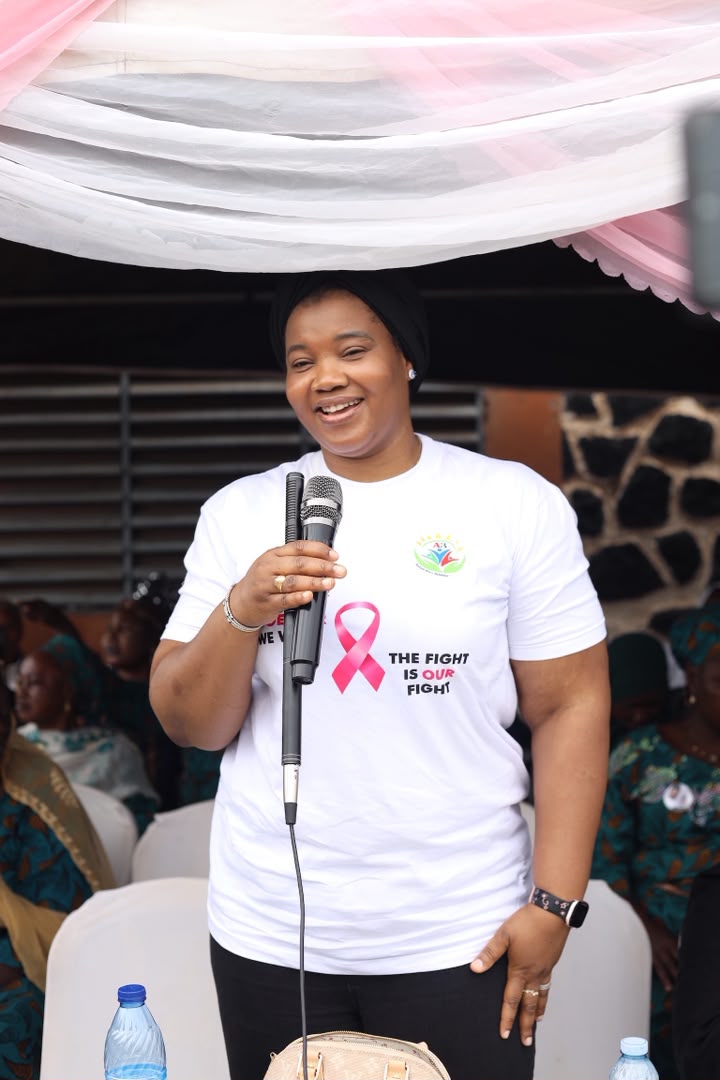
..as founde urges residents to prioritise health, early detection
By Salam Saheed
The Aishat Aliyu Adeleke Foundation (A3 Foundation) has taken its breast and prostate cancer awareness campaign to communities across Ifedapo Federal Constituency in Oyo State, urging residents to prioritise their health, embrace early detection and seek appropriate medical attention whenever necessary.
The five-day community initiative, held from October 6 to 10, 2026, covered Oje-Owode in Saki East LGA, Ofiki in ATISBO LGA and Saki town in Saki West LGA.
The programme, themed “Early Detection Saves Lives: Know Your Risk, Get Screened,” featured health education, community engagement, free blood pressure and blood sugar checks, screening and referral guidance, distribution of educational materials to pupils, a birthday thanksgiving service and a five-lap breast cancer awareness walk.
Speaking during the programme, the founder of the foundation, Aishat Aliyu Adeleke, expressed satisfaction with the level of participation and the success of the initiative, stressing that health remained essential to human welfare and community development.
Adeleke, who reiterated the popular saying that health is wealth, encouraged women and other members of the public to take proper care of themselves and pay closer attention to their health.
She emphasised the need for people to embrace preventive healthcare, seek medical advice when necessary and take advantage of opportunities for health education and screening.
The founder explained that the foundation’s intervention was part of its commitment to raising awareness, promoting early detection and supporting communities towards a healthier future.
The campaign began on October 6 at Oje-Owode in Saki East LGA, where residents received education on breast and prostate cancer, their risk factors, warning signs and the importance of timely medical evaluation.
Participants also benefited from community engagement sessions, free blood pressure and blood sugar checks, as well as information on screening and referral services.
The outreach continued on October 7 at Ofiki in Atisbo LGA, where the organisers intensified awareness on the importance of early detection and regular medical checks.
The session featured health talks, question-and-answer discussions and free blood pressure and blood sugar checks, giving residents an opportunity to learn more about cancer prevention, warning signs and available healthcare options.
The major community outreach took place on October 8 in Saki town, Saki West LGA, where health professionals addressed participants on breast and prostate cancer education.
Among the speakers were the Provost of the College of Nursing Sciences, Saki, Alhaja Sanni Olalere, and the Managing Director of Al-Safurat Hospital, Saki, Madam Adeleke Bilkisu Toyin.
In her presentation on breast and prostate cancer education, The Provost emphasised the importance of public awareness, early detection and access to timely medical care.
She explained that breast cancer develops when abnormal cells in the breast grow uncontrollably and may spread to other parts of the body, noting that although the disease predominantly affects women, men can also develop it.
She identified possible warning signs of breast cancer to include a new lump in the breast or armpit, changes in breast size or shape, dimpling of the skin, changes in the nipple and unusual nipple discharge.
Olalere explained that risk factors could include increasing age, family history, certain inherited genetic mutations, alcohol consumption and some hormonal and reproductive factors.
She encouraged women to become familiar with the normal appearance and feel of their breasts and promptly seek medical evaluation when they noticed unusual changes.
On prostate cancer, she explained that the disease develops in the prostate gland, a small gland in men that produces fluid forming part of semen.
She noted that prostate cancer was more common among older men, although younger men could also develop the disease.
Possible symptoms, she said, included difficulty urinating, a weak urine stream, frequent urination and blood in the urine or semen. She added that some patients might not experience noticeable symptoms in the early stages.
Olalere stressed that the symptoms could also result from non-cancerous prostate conditions, making professional medical evaluation necessary.
She urged men, particularly those with a family history of prostate cancer, to discuss their individual risk and appropriate screening options with qualified healthcare professionals.
Participants were therefore encouraged to seek reliable medical information, consider recommended HPV vaccination and cervical screening, and avoid relying on unverified claims about the causes of cancer.
Also speaking at the Saki outreach, the Managing Director of Al-Safurat Hospital, Madam Adeleke Bilkisu Toyin, expressed concern over what she described as the reluctance of some residents to seek appropriate medical attention when faced with serious health challenges.
She explained the difference between malignant and benign tumours, noting that malignant tumours were cancerous growths capable of invading surrounding tissues and spreading to other parts of the body.
She said benign tumours were generally non-cancerous and did not spread to distant parts of the body, although some could cause serious complications depending on their size and location.
The hospital administrator expressed concern over cases in which patients delayed seeking medical care, attributing their illnesses to spiritual attacks and resorting to herbal or metaphysical remedies instead of pursuing appropriate medical evaluation.
She argued that such delays could prevent patients from receiving timely diagnosis and treatment, urging residents to seek professional medical advice whenever they experienced persistent or unusual symptoms.
Toyin further claimed that about 80 per cent of people who died in Saki did so because of what she described as carelessness, particularly reluctance to seek referrals to better-equipped medical facilities outside the town.
She, however, did not provide statistical evidence to substantiate the figure during the programme.
The hospital administrator maintained that some hospitals in Saki had limited capacity to manage certain complex medical conditions, stressing the importance of referring patients to facilities with the necessary specialists and diagnostic equipment.
She identified the University of Ilorin Teaching Hospital, Ilorin; University College Hospital, Ibadan; and Ladoke Akintola University of Technology Teaching Hospital, Ogbomoso, as facilities where patients could seek specialised medical attention when appropriately referred.
She urged residents to take referrals seriously and avoid allowing fear, misinformation or misconceptions to prevent them from accessing professional healthcare.
The health awareness programme also featured free blood pressure and blood sugar checks, while participants received guidance on screening and referral options.
As part of its educational intervention, the foundation distributed educational materials to pupils of LA Primary School, Isale Taba, Saki, and LA Primary School, Isia, Saki.
The pupils were encouraged to face their studies squarely, remain disciplined and take their education seriously as a foundation for future success.
The organisers explained that the school outreach reflected the foundation’s broader commitment to community development, combining health awareness with educational support for young people.
Activities continued on October 9 with a birthday thanksgiving programme in honour of the founder. The day featured a Jumaat prayer at Saki Central Mosque, donations of essential items and expressions of appreciation to members of the community.
The programme concluded on October 10 with “Down 4 War Ridaz,” a five-lap breast cancer awareness walk organised to promote public consciousness about the disease and encourage residents to take preventive healthcare seriously.
The walk attracted volunteers, sports enthusiasts and members of the Adeleke family, who participated in the exercise to support the campaign’s message of awareness, early detection and community solidarity.
Some participants who spoke during the programme described A3 Founder as a compassionate personality who had consistently demonstrated a willingness to assist others and contribute to societal development.
They expressed admiration for her decision to continue giving back to the community despite setbacks in her political aspirations, noting that public service and humanitarian contributions should not be limited by political interests.
The participants urged other well-meaning individuals to support community development initiatives and use their resources, influence and opportunities to improve the welfare of others.