

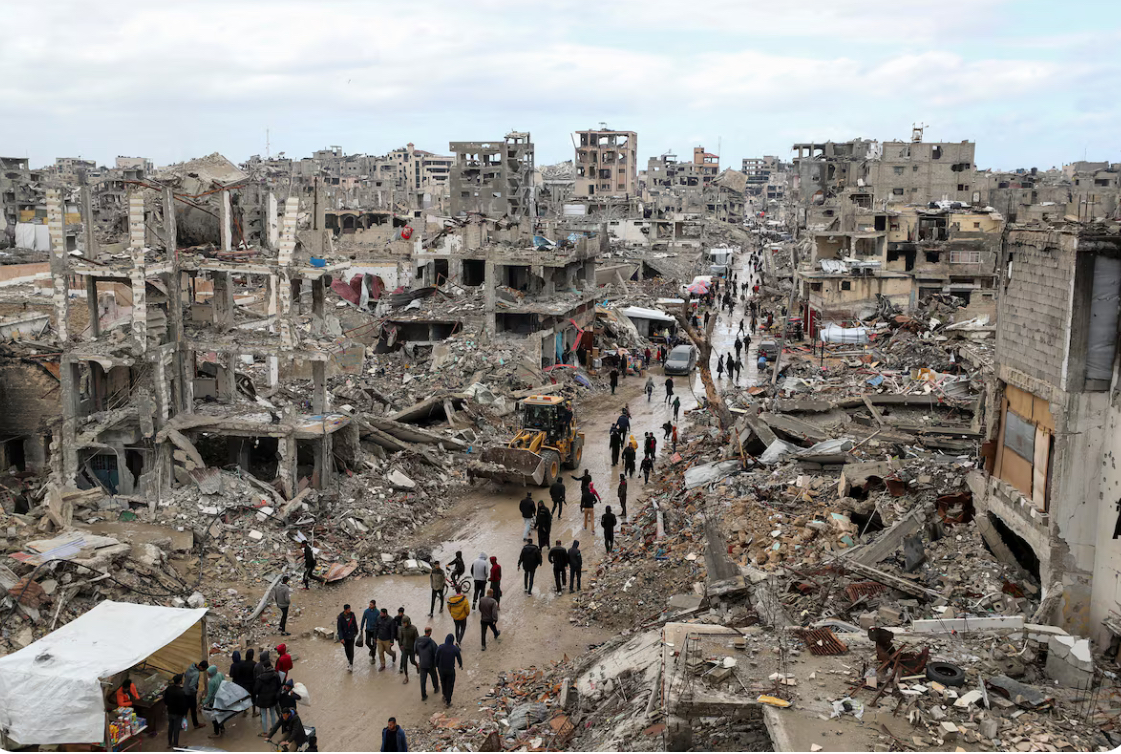
One of the greatest tragedies befalling the world in recent times is the seeming helplessness of nations as they watch Israel unfold and unleash her plans to annihilate Palestinians through a forceful annexation of Gaza. After some weeks of a temporary ceasefire, anarchy and doom seem to have descended on Gaza as the Israeli military is poised to execute an expanded and forceful takeover. The operation—code-named “Operation Gideon’s Chariots”—is expected to last four to six months. Since the announcement, Israel’s killing spree has continued unabated. Gaza, it is said, faces annihilation.
The Israeli military’s forceful takeover of Gaza, if it continues and consolidates, carries profound humanitarian, political, legal, and geopolitical consequences. Already, the city is under intense aerial attack as Israeli forces launch operations to seize control of Gaza. Scores of people, mostly women and children, have been deliberately killed, particularly in the residential districts of Zeitoun and Sabra.
Although international condemnation has intensified over the humanitarian consequences of the Israeli action, there has been no serious or deliberate effort to stop Israel. More than two million Palestinians remain trapped in Gaza, where the United Nations warns of widespread famine and severely limited access to aid. Tragically, according to the UN, the quantity of humanitarian supplies reaching Gaza by land and airdrop is far below what is required.
Amid this humanitarian crisis, the UK, EU, Australia, Canada, and Japan groan with suspended breath. Where do we go from here? Where is our humanity? They seem to ask. They demand an end to the use of lethal force near aid distribution sites and lorry convoys, where the UN reports that more than 1,300 Palestinians have been killed—mostly by Israeli forces. On its part, the World Health Organisation (WHO) has recently appealed to Israel to allow the delivery of vital medical supplies to deal with the catastrophic health situation in Gaza.
All hands must be on deck to forestall the impending doom in Gaza. It is tragic that, despite all entreaties, Israel remains bent on bombing Gaza into complete ruin. On July 19, 2024, the International Court of Justice (ICJ) issued an advisory opinion declaring that Israel’s occupation of Palestinian territories, including Gaza, is unlawful and must end. Israel has ignored this opinion. The ICJ had issued further orders emphasising unhindered distribution of humanitarian aid, the opening and expansion of border crossings, and refraining from any military conduct likely to violate Palestinian protections under the Genocide Convention. Again, Israel ignored or failed to implement the ICJ’s provisional measures.
The international community needs to do more in the face of such aggression. People of conscience around the world must stand up now to prevent an impending genocide. Global leaders and institutions must take decisive action to hold Israel accountable for actions that contravene international law and basic human rights.
The United States, in particular, bears a significant responsibility. Its unconditional support for Israel has, in many ways, emboldened Israel’s aggressive policies. President Trump’s policies in the Middle East—including the recognition of Jerusalem as Israel’s capital—were perceived as one-sided and further inflamed tensions in the region. Unfortunately, Israeli Prime Minister Benjamin Netanyahu has boastfully declared that the renewed bombing of Gaza is “only the beginning” and that Israel will press ahead until it achieves all its war aims, including destroying Hamas.
The U.S. and Israel have reportedly “reached out to officials of three East African governments to discuss using their territories as potential destinations for relocating Palestinians uprooted from the Gaza Strip under President Donald Trump’s proposed post-war plan.” The East African governments must reject such a proposal. They should not agree to lend out their territory for such an illegal project.
While much of the international focus is often on Israel’s actions, it is equally important to address the role of Hamas in this protracted conflict. Hamas’s tactics—such as launching rocket attacks into Israeli territory—have escalated tensions and provoked military responses. For example, if Hamas had not initiated hostilities by attacking Israel, the current round of conflict might not have erupted in the same way. These hostilities contribute to a cycle of violence that makes peace more elusive, hardens public opinion on both sides, and complicates international mediation.
Hamas has fired thousands of rockets into Israeli territory, deliberately targeting civilian areas. These attacks have killed and injured Israeli civilians and created an atmosphere of fear and insecurity. On October 7, 2023, Hamas launched a large-scale incursion into Israel, killing civilians and taking hostages, which triggered the latest and most intense phase of the war. Hamas has embedded military infrastructure—such as weapons storage facilities, command centres, and tunnels—within or beneath densely populated civilian areas in Gaza.
This complicates Israel’s military response and places Palestinian civilians in direct danger. At different times, Hamas has rejected ceasefire proposals or set conditions that stalled negotiations, thereby prolonging hostilities. While many Palestinians oppose Hamas’s tactics, a portion of the population supports or tolerates them, viewing Hamas as a form of resistance against occupation and blockade. This support, whether active or passive, strengthens Hamas’s political and military position.
Of course, the roots of the Israeli-Palestinian conflict are deep and complex, dating back over a century. Those working for peace in the region must take note of these important historical facts, as they are the only way to fully understand the conflict. The early 20th century saw the rise of both Jewish and Arab nationalism in the region of Palestine, then under Ottoman and later British rule. The aftermath of World War II and the Holocaust intensified the demand for a Jewish homeland, leading to the United Nations’ 1947 partition plan, which proposed separate Jewish and Arab states. This plan was accepted by Jewish leaders but rejected by Arab leaders, resulting in the 1948 Arab-Israeli War and the establishment of the State of Israel.
In the light of the enduring conflict and the recent tragic events, a sustainable and just solution to the Israeli-Palestinian conflict in Gaza is imperative. The two-state solution—rooted in international law and envisioning an independent State of Palestine alongside the State of Israel—remains the most viable path to peace.
In the meantime, a mutual ceasefire in Gaza should be established. Hostages and prisoners should be released in phases. Humanitarian aid must be restored and depoliticised. Water, power, and shelter should be reinstated. Hospitals must be protected. A framework for post-war governance and security in Gaza should be created.
A demilitarisation-and-integration process should be fast-tracked to usher in the much-vaunted ceasefire and peace in Gaza. Sanctions and accountability for violations of international humanitarian law—by any party—through credible investigations and judicial processes must be enforced. This would deter recurrence and affirm equal human dignity. Existing ICJ and United Nations’ decisions demanding an immediate ceasefire in Gaza and the release of hostages must also be implemented. Non-compliance should be treated as a breach to be met with sanctions. Border crossings and unfettered humanitarian access must be guaranteed, and the protection of aid convoys must be ensured so that humanitarian supplies reach the many hungry and injured people in Gaza.
An expanded Israeli takeover of Gaza may yield short-term military control, but the long-term costs—humanitarian disaster, intensified resistance, international isolation, regional instability, and the death of the two-state solution—could be catastrophic. The time to act is now.
Credit:The Guardian