

••urges FG to improve healthcare workers’ welfare.
By Salam Saheed
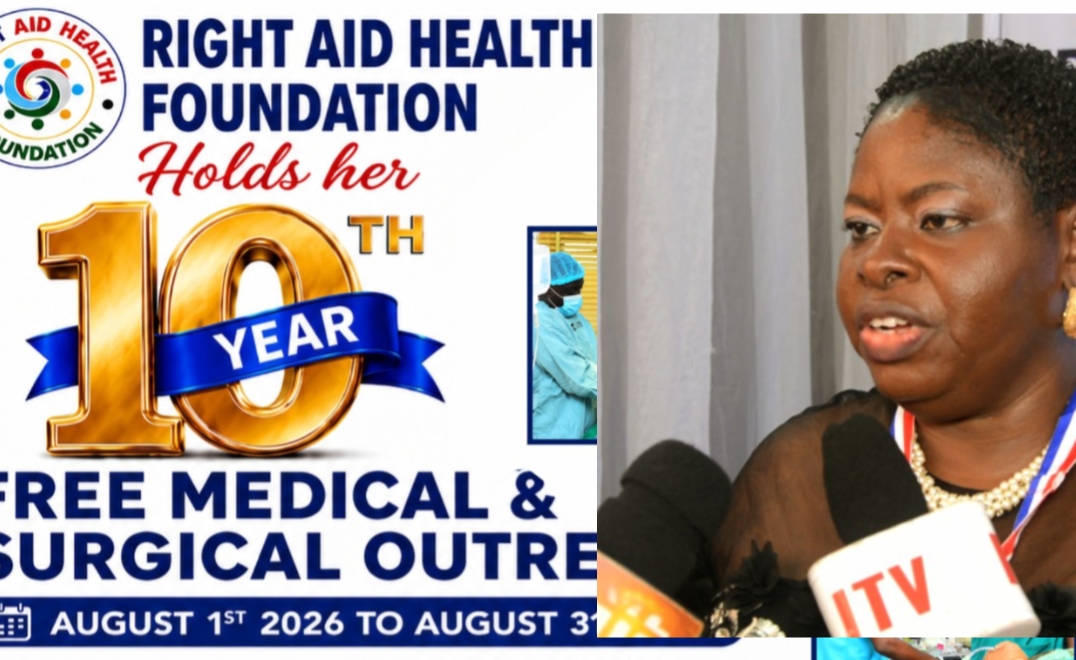
The Right Aid Health Foundation has marked its 10th anniversary with a call for increased investment in surgical healthcare, improved welfare for medical professionals and greater access to affordable surgical interventions for underserved Nigerians.
The foundation made the call at its 10th anniversary gala and award ceremony held at Hall 36, Lagos University Teaching Hospital (LUTH), Idi-Araba, Lagos, on Saturday.
The anniversary celebration was held alongside the foundation’s month-long free medical and surgical outreach, organised in collaboration with Onelife Hospital and the Africa Vision Tract House Society (AVTHS), the missionary arm of the Nigeria Christian Graduate Fellowship.
Speaking at the event, the founder of the foundation, Professor Oyebola Olubodun Adekola, expressed gratitude to God for enabling the organisation to touch lives, restore hope and provide medical interventions to the less privileged over the past decade.
Adekola, a professor of anaesthesia and critical care, also appreciated her colleagues, volunteers, sponsors and other participants who contributed resources and expertise towards the foundation’s humanitarian activities.
She appealed to well-meaning Nigerians, corporate organisations and other stakeholders to support the foundation financially, noting that many indigent patients still require surgical intervention but are unable to afford the cost of treatment.
According to her, the foundation’s surgical interventions include cataract and pterygium surgeries, fibroid treatment, goitre surgery, inguinal and femoral hernia repair, umbilical hernia repair, appendicectomy, lipoma excision, management of breast lumps and breast cancer, as well as treatment of prostate enlargement.
She disclosed that more than 3,000 patients had benefited from the foundation’s medical and surgical outreach programmes.
Adekola said the foundation’s intervention was driven by a commitment to humanitarian service, expressing optimism that it would expand beyond Lagos State and reach underserved communities across Nigeria in the next decade.
She also raised concern over the continued migration of healthcare professionals under the “Japa syndrome”, describing the development as one of the factors contributing to the challenges confronting Nigeria’s health sector.
She urged the Federal Government to improve the remuneration, welfare packages and working conditions of healthcare workers to encourage professionals to remain in the country and contribute to strengthening the health system.
“Our commitment is to touch more lives in the next 10 years. We are optimistic that the foundation will have independent facilities to enable us to carry out more interventions and reach more people,” she said.
The keynote speaker, Dr Lanre Shoyinka, Managing Director of Oohbee Hospital, Egbe, in his presentation titled “Burden of Surgery in Nigeria: Reaching the Unreached,” said the most significant surgical challenge was not necessarily the patient already in the hospital, but the patient who never gets there.
Shoyinka said there was a significant gap between people who needed surgery and those who eventually received surgical care, adding that the problem was compounded by financial, geographical, cultural and systemic barriers.
He identified some of the unreached patients as people living for years with hernias because of misconceptions about surgery, women who delay evaluation of breast lumps because they cannot afford diagnostic investigations, children with congenital conditions whose families cannot afford transportation to tertiary hospitals, and patients with postpartum haemorrhage who are unable to access emergency transportation at night.
According to him, such patients often remain outside official hospital statistics and mortality reviews, despite constituting a significant component of Nigeria’s surgical disease burden.
He said surgery intersects with maternal and child health, trauma, cancer, congenital abnormalities and conditions associated with ageing, stressing that public health messaging alone could not address diseases requiring surgical intervention.
Shoyinka cited the Lancet Commission on Global Surgery’s estimate that billions of people globally lack access to safe and affordable surgical and anaesthetic care when needed.
He described Nigeria’s surgical workforce and procedural capacity as inadequate, noting that the country had a major gap in the availability of surgeons and essential surgical services.
He identified the financially, culturally, geographically and systematically unreached as among those who face barriers to surgical care.
According to him, some patients reach health facilities only to encounter a shortage of surgeons, operating theatres, anaesthetists, blood products or funds to proceed with treatment.
He also drew attention to what he described as the “invisibly unreached” — patients whose conditions had become normalised over time, including women living with large fibroids and patients with chronic wounds who had accepted disability as part of their lives.
The medical expert called for the decentralisation of appropriate surgical services through general hospitals, district hospitals, comprehensive health centres, referral hospitals and tertiary institutions.
He argued that ,patients requiring relatively straightforward procedures, such as uncomplicated inguinal hernia repair, should not necessarily have to navigate the same healthcare pathway as patients requiring highly specialised procedures such as complex neurosurgery.
He advocated the development of multidisciplinary surgical teams rather than relying on individual “surgical heroes”, while urging healthcare authorities to identify, train and monitor doctors capable of performing appropriate basic surgical procedures at rural and suburban health facilities.
Shoyinka said Nigeria must focus on finding patients before their conditions became catastrophic, bringing essential surgical services closer to communities, ensuring that referral did not become a barrier to survival, making surgery financially accessible and retaining trained healthcare professionals.
“Most importantly, we should recognise that access to surgery is not a privilege,” he said.
The Provost of the College of Medicine, University of Lagos, Professor Ademola Ayodele Oremosu, commended the Right Aid Health Foundation for sustaining its free community medical services over the past decade.
Oremosu said providing free medical services required significant resources and commitment, describing the foundation’s 10-year intervention as a demonstration of compassion and service to humanity.
He encouraged the foundation and its founder to sustain the initiative, urging individuals and organisations with the capacity to support healthcare delivery to emulate the gesture.
He said collaborative efforts between government, non-governmental organisations, medical professionals and private-sector stakeholders remained essential because government could not shoulder the entire burden of healthcare delivery alone.
Other speakers at the event also commended the foundation and organisations such as the Association of Rural Surgical Practitioners of Nigeria (ARSPON) for contributing to improved access to healthcare.
They called for stronger partnerships and collaborative interventions to expand the reach of free and affordable medical and surgical services to underserved communities.
Some beneficiaries of the foundation’s interventions expressed appreciation for the assistance they received, saying the free medical and surgical services had restored hope to patients who could not afford treatment.
They prayed for the founder and the foundation to continue its humanitarian work and celebrate many more anniversaries in the service of humanity.
The Right Aid Health Foundation’s 10th anniversary outreach, which runs from August 1 to August 31, 2026, provides free medical care, medication and surgical interventions at Onelife Hospital, 485 Agege Motor Road, Bolade/Oshodi, Lagos.
The outreach covers general medical consultation, ophthalmic and optometric services, laboratory and diagnostic investigations, cervical, breast and prostate screening, health education and counselling, alongside surgical interventions for selected conditions.
The foundation described the initiative as part of its commitment to providing “quality healthcare, compassionate service and restoring hope” to underserved Nigerians.