

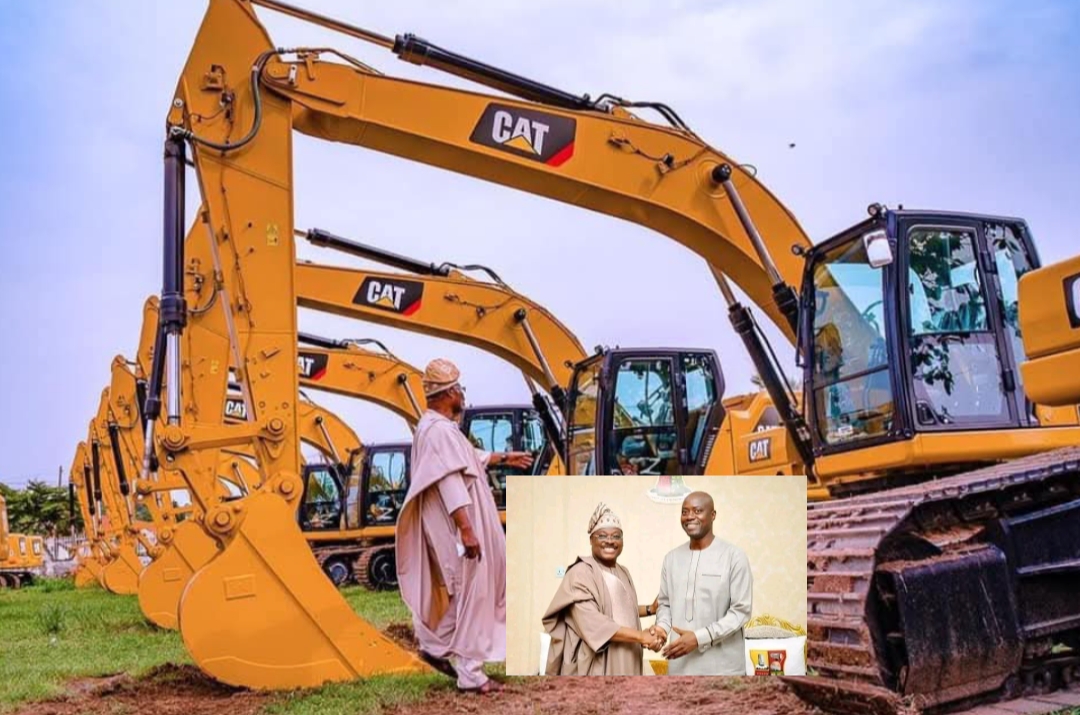
I am concerned about the alleged sale of tractors acquired by the late former Governor of Oyo State, Senator Abiola Ajimobi, for agricultural development, reportedly as scrap under the administration of Governor Seyi Makinde. If this allegation is established, it raises serious questions about the management of public assets, accountability and the continuity of agricultural policies in the state.
My concern is straightforward: what happened to the tractors, why were they allegedly disposed of, who authorised the transaction, and where did the proceeds go?
These are questions the people of Oyo State deserve to have answered.
The tractors were reportedly acquired to support farmers across the state’s 33 local government areas, promote mechanised farming, reduce the burden of manual labour and improve food production. Public investments of this nature are intended to serve citizens beyond the tenure of the administration that procures them.
If the equipment had become unusable, the government should be able to explain its condition, the steps taken to repair or replace it and the basis for any decision to dispose of it. If the tractors were sold as scrap, the state government should disclose the relevant records, including the valuation, sale price, buyers and destination of the proceeds.
I believe that accountability should not depend on which political party is in power. Public assets belong to the people, and every administration has a responsibility to protect them, maintain them and account for their disposal.
The Agricultural Question
Agriculture remains an important part of Oyo State’s economy, particularly for rural communities whose livelihoods depend on farming and related activities. Access to mechanised equipment can help farmers cultivate larger areas of land, reduce production costs and improve efficiency.
Against this background, the alleged disposal of tractors acquired for agricultural purposes deserves proper investigation.
I do not believe that accusations and counter-accusations should replace documentary evidence. The relevant records should establish how many tractors were acquired under the Ajimobi administration, how many remained in service when Makinde assumed office, their condition at the time and whether any were subsequently sold or otherwise disposed of.
The government should also explain the state of its agricultural mechanisation programme and identify the measures taken to ensure that farmers have access to the equipment and support they need.
For me, this is not simply a disagreement between supporters of two former and current governors. It is a question of how public resources are managed and whether the people receive the value intended from government expenditure.
Will Bimbo Adekanbi Offer a Different Direction?
As discussions surrounding the 2027 governorship election gather momentum, Bimbo Adekanbi’s political association with Makinde and his reported ambition to succeed the governor under the platform of the Allied Peoples Movement (APM) raise another important question: what would his administration do differently?
I ask this question because a candidate seeking to succeed an incumbent governor should be prepared to explain his position on the administration’s policies, achievements, shortcomings and unresolved public concerns.
Adekanbi should tell the people of Oyo State how he intends to manage public assets, strengthen agricultural production, improve infrastructure and ensure transparency in government transactions.
Would he undertake a review of the state’s agricultural equipment and establish a transparent system for tracking government-owned machinery? Would he publish periodic reports on the utilisation of public assets? Would he make the rehabilitation, replacement or procurement of agricultural equipment part of a clearly defined policy for supporting farmers?
These are practical questions that deserve answers from anyone seeking the state’s highest political office.
I also believe Adekanbi should clarify the extent to which his proposed policies would differ from those of the outgoing administration. Political association does not automatically establish that a successor would reproduce every policy of an incumbent. However, voters are entitled to ask candidates to explain where they agree with the existing government and where they intend to pursue a different course.
The same standard should apply to every candidate, regardless of party affiliation.
APM And The Question Of Continuity
The choice of political platform is another issue for public discussion. Adekanbi’s reported alignment with the APM has generated questions about the party’s policy direction and its relationship with the current administration.
In my view, the debate should go beyond party labels and campaign slogans. Voters need to understand the party’s programme for agriculture, education, healthcare, infrastructure, employment and public finance.
If the APM presents itself as a vehicle for continuity, it should explain which policies it intends to retain and how it plans to address concerns about their implementation. If it promises a departure from the existing administration, it should identify the changes it intends to introduce and explain how they would be funded and implemented.
The expression *Omituntun 3.0*, associated with the prospect of continuing Makinde’s political agenda, cannot by itself answer these questions. What matters is the substance of the proposed policies, the accountability mechanisms behind them and the people who would be responsible for implementation.
I believe that political branding should not substitute for a detailed programme of government.
Public Debt And Management Of Assets
Beyond the tractors, I am concerned about the broader questions surrounding public expenditure, borrowing and the management of government property in Oyo State.
Borrowing is not automatically evidence of fiscal irresponsibility, just as selling an asset is not necessarily proof of wrongdoing. Both require scrutiny of the circumstances, the purpose, the financial implications and the benefits to the public.
Where loans are obtained, citizens should be able to determine how the money is used, the projects it finances, the repayment obligations involved and the expected benefits. Where public assets are disposed of, the government should provide a clear account of the reasons, the valuation process and the proceeds realised.
This is the standard I believe Oyo State should adopt, irrespective of the party in power.
The Makinde administration should therefore address the allegation concerning Ajimobi-era tractors with verifiable information rather than allowing the controversy to remain a subject of political exchanges.
Adekanbi, in turn, should use the opportunity to state his position on transparency, agricultural investment and the protection of public assets.
The People Deserve Answers
I maintain that the alleged sale of Ajimobi’s tractors as scrap should be treated as an issue requiring evidence, clarification and accountability. The allegation should not be regarded as established fact until relevant records and responses from the government are available.
Nevertheless, the questions raised by the controversy are important. What became of the equipment? What was its condition? Was it disposed of, and, if so, under what terms? What became of the proceeds? What safeguards exist to prevent the loss or improper disposal of other public assets?
The Makinde administration should provide answers to these questions.
Adekanbi should also explain what his candidacy represents beyond his association with the outgoing governor. If he seeks to lead Oyo State, he must be prepared to articulate his own priorities and account for the policies he intends to pursue.
Ultimately, the people of Oyo State deserve a political debate based on evidence, clear policy proposals and measurable commitments. The management of public assets, the future of agriculture and the responsible use of public funds should form part of that debate ahead of the 2027 governorship election.
For me, the central question remains: **if the allegation concerning the tractors is substantiated, what lessons will Makinde’s administration draw from it, and what concrete assurances will Bimbo Adekanbi offer that public assets will be managed transparently under any government he seeks to lead?
That is a question both the outgoing administration and those seeking to succeed it should be prepared to answer.
David Oluokun
BSA Voice of Reason Media & RHAIN Coordinator