

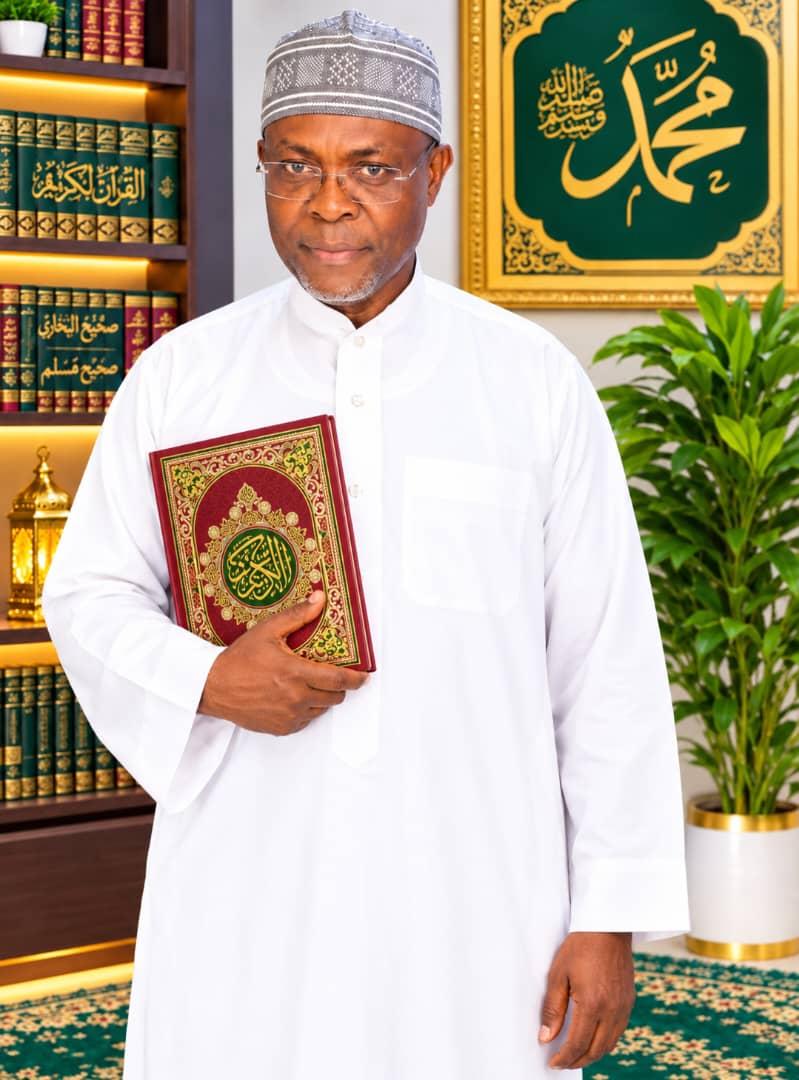
In this interview, Muhawiyyah Ibrahim Akanji speaks with Chief Muhammad Mustapha Ekene Akunna in Abuja about his journey from Christianity to Islam, what influenced his decision, and how embracing Islam has brought him peace of mind.
At 62, when many people have spent decades identifying with a particular faith and way of life, Chief Muhammad Mustapha Ekene Akunna, formerly known as Chief Victor Ekene Akunna, has embraced Islam, describing the experience as a turning point that has brought him happiness and peace of mind.
Born on April 22, 1964, in Ohaji/Egbema, Oguta-Egbuoma, Imo State, the Igbo businessman embraced Islam on October 1, 2026, in Gwagwalada, Abuja, after years of interaction with Muslims through personal relationships and business engagements.
Reflecting on his decision, the new Muslim said he had found a renewed sense of purpose and tranquillity in his new faith.
“I was so happy. I found life and peace of mind,” he said.
His conversion, he explained, followed a gradual process of learning, personal reflection and interaction with Muslims, which helped him overcome some of his earlier misconceptions about Islam.
How Friendship And Business Influenced His Journey
Chief Muhammad Mustapha said his journey towards Islam did not begin on the day he formally embraced the religion.
For several years, he had maintained business relationships with Moroccan and Turkish associates, some of whom had called him Mustapha for more than two decades, even before his conversion.
He also disclosed that three of his children already had Muslim names.
Despite his longstanding association with Muslims, he admitted that his initial perception of Islam had been influenced by reports of terrorist attacks and the use of the phrase Allahu Akbar by individuals involved in violence.
However, his subsequent interactions with Muslims gradually changed his understanding of the religion.
“I discovered Islam is peace and a way of life,” he said.
One of the individuals who played a role in his journey was Senator Muhammad Dauda, the Federal Capital Territory coordinator of the Nigerian Youth Alliance for Tinubu.
According to him, their relationship began at an All Progressives Congress (APC) programme in Maitama, Abuja, and developed through subsequent political engagements.
Chief Muhammad Mustapha said Senator Dauda occasionally asked him, jokingly, whether he would consider becoming a Muslim.
Although the question was initially raised casually, their friendship provided an opportunity for further discussions and exposure to Islam.
National Mosque Visit Deepened His Interest
Another significant experience came when Chief Muhammad Mustapha expressed an interest in visiting the National Mosque in Abuja.
He said Senator Dauda accompanied him to the mosque, where he received a warm welcome.
The experience, according to him, further challenged his previous assumptions about Islam and strengthened his interest in understanding the religion.
His eventual decision to embrace Islam on October 1, 2026, marked the culmination of a personal journey that had developed over several years.
After pronouncing the Shahadah, the declaration of faith through which a person enters Islam, he was taken to a mosque, where he performed ghusl, the ritual bath associated with his conversion experience.
Recalling the occasion, he said his overwhelming feeling was happiness and a sense of inner peace.
Why He Adopted The Name Muhammad Mustapha
The transition from Victor Ekene Akunna to Muhammad Mustapha Ekene Akunna also reflected his new religious identity.
He explained that the name Mustapha had been given to him by his Moroccan and Turkish business associates many years before his conversion.
The name Muhammad was subsequently given to him by Mallam Ya’qub, who was connected with his conversion, and Senator Muhammad Dauda.
The new name now represents an important part of his identity as a Muslim.
However, he maintained that his decision was personal and not influenced by pressure from friends, relatives or business associates.
“My happiness is not for anybody; it’s a self-happiness,” he said.
He added that his family and friends had received his decision positively, noting that his wife, who is a white woman, also accepted his conversion.
According to him, he did not experience any particular difficulty with his family following his decision.
Finds Acceptance Among Igbo Muslims
Following his conversion, Chief Muhammad Mustapha was introduced to members of the Igbo Muslim community at the National Mosque in Abuja.
He said the reception he received reinforced his understanding of the sense of brotherhood among Muslims, irrespective of ethnic background.
His experience, he noted, had encouraged him to build relationships with other Muslims and deepen his understanding of the faith.
He also disclosed that he had begun encouraging a friend to consider Islam, although his own priority remained learning and practising the religion.
Enrols In New Muslim Class
Despite his age and years of experience as a businessman, Chief Muhammad Mustapha has embraced the role of a student as he begins his new religious journey.
He said he had purchased a translated copy of the Qur’an and was gradually learning its teachings and putting them into practice.
He has also enrolled in the New Muslim Class at the Abuja National Mosque, where he is receiving further guidance on Islamic beliefs and practices.
On October 18, 2026, he attended the Friday Jumu’ah prayer at the National Mosque.
He identified language barriers and the need to understand Islamic etiquette, modesty and appropriate interactions between men and women as some of the areas in which he was still learning.
Rather than viewing these as obstacles, he said he was committed to understanding and practising his new faith gradually.
Asked about the most important lesson he had learnt since embracing Islam, he said: “I learned that Islam is not a difficult religion.”
He added that his new faith had helped him approach life with greater simplicity and peace of mind.
Urges Muslims To Fear Allah
Chief Muhammad Mustapha also called on Muslims to demonstrate sincerity and good character in their daily lives.
He urged them to remain conscious of Allah in their dealings with others and to allow their conduct to reflect the teachings of Islam.
“They should fear Allah in whatever they do,” he said, advising young people in particular to make the fear of Allah a guiding principle in their decisions.
He also observed that some Muslims who were born into the religion might not fully appreciate its blessings because they had grown up practising it.
For him, discovering Islam later in life has strengthened his appreciation of the faith and his determination to learn more about its teachings.
He further urged people to study Islam based on its authentic teachings rather than judge the religion by acts of terrorism or violence committed by individuals who claim to represent it.
According to him, the actions of such individuals should not be allowed to define a religion that he has come to understand as a way of life founded on peace and submission to Allah.
Why His Story Deserves To Be Told
Explaining the motivation behind documenting Chief Muhammad Mustapha’s experience, the writer said his connection with Senator Muhammad Dauda provided the opportunity to meet the businessman after learning that he had recently embraced Islam.
What stood out, however, was not merely the decision of a 62-year-old man to change his religious affiliation, but his determination to understand and practise his new faith.
His willingness to learn the Qur’an, attend Islamic classes, interact with Muslims and seek knowledge demonstrated a commitment that the writer considered worthy of public attention.
The story also carries a message for people who may be interested in Islam but are apprehensive about the consequences of embracing the religion.
For some, such fears may concern family relationships, friendships, business partnerships or the possible reactions of society.
Chief Muhammad Mustapha’s experience illustrates that a person’s search for religious understanding can continue at any stage of life.
It also offers an opportunity for Muslims to reflect on the value of the faith they may have practised since childhood.
Access to the Qur’an, the call to prayer, mosques and the opportunity to worship are blessings that may sometimes be taken for granted by those who have grown up within the religion.
For someone who has embraced Islam after decades of practising another faith, however, these experiences may carry a renewed significance.
‘Allah Gave Us Everything For Free’
At the heart of Chief Muhammad Mustapha’s reflections is his belief that the blessings of life should inspire gratitude and worship.
He posed a question that captures his understanding of humanity’s relationship with the Creator: if Allah has given people everything freely, why should they not worship Him?
For him, life, health, family and the opportunities people enjoy are blessings that should encourage them to recognise and appreciate their Creator.
His message to those interested in Islam is to approach the religion sincerely, study its teachings and allow its principles to influence their behaviour.
He also urged Muslims to recognise that identifying with Islam carries a responsibility to demonstrate good character and live by its teachings.
A Journey Still Unfolding
Chief Muhammad Mustapha’s story is far from complete.
He is still learning Arabic, studying the Qur’an, familiarising himself with Islamic prayers and seeking a deeper understanding of the Sunnah.
At 62, he has embarked on a new journey as a businessman, father and recent convert to Islam, determined to acquire the knowledge necessary to practise his faith.
His experience serves as a reminder that the search for truth does not necessarily end with age and that a sincere desire for understanding can lead people to reconsider long-held beliefs.
As he continues his journey, he hopes his experience will reach people across the world and inspire future generations.
For Chief Muhammad Mustapha, embracing Islam is not merely a change of name or religious identity. It is the beginning of a new chapter that he says has brought him happiness, purpose and peace of mind.
“Allah gave us everything for free. Why won’t we worship Allah?”
For him, the question captures the conviction at the heart of his decision and the beginning of his journey as a Muslim.
By Muhawiyyah Ibrahim Akanji is an educator in Abuja