
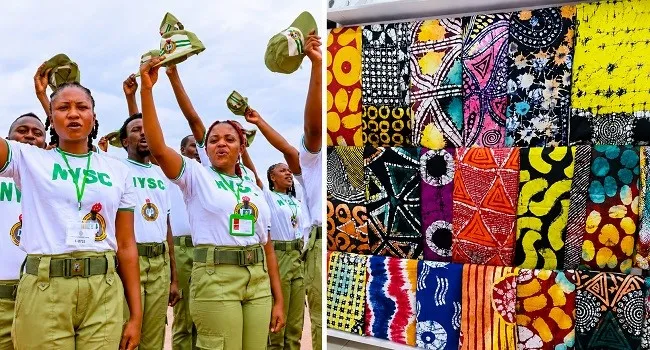
National Anthem Change, NYSC Adire Debate: Are These Nigeria’s Real Priorities? by bennybuhari(op): 4:35pm On Jul 06
In Nigeria today, under the Bola Ahmed Tinubu presidency, it is one week, one trouble. Maybe one week, one distraction. This government behaves like a seasoned trickster, always with another trick up its sleeve to hoodwink the citizens. Rather than confronting its failures head-on and proffering solutions, it repeatedly shifts public attention to distractions, manufactured controversies, and symbolic battles that do little to improve people’s lives. These non-issues dominate headlines and public debate, consuming the time and energy that should be spent examining the government’s record.
The strategy is as effective as it is cynical: keep citizens arguing over trivialities, and they are less likely to notice policy blunders, broken promises, incompetence, and poor governance. Every distraction serves as a smokescreen, obscuring the real issues that affect the public. A government confident in its performance would welcome scrutiny; a government that constantly seeks to divert attention invites questions about what it is trying to hide.
Although the presidency has yet to provide concrete answers to the questions Nigerians are asking about the Gbajabiamila/Adeyemi saga and the non-existent Presidential Foreign Intervention Promotion Council (PFIPC) and Presidential Economic Advisory Council (PEAC), which I wrote about last week, the latest controversy surrounding the proposal to replace the National Youth Service Corps (NYSC) khaki uniform with adire fabric also deserves scrutiny.
The debate has become significant because it touches on a recurring concern among Nigerians: the apparent mismatch between government priorities and the urgent realities confronting citizens.
Last week, the minister of youth development, Ayodele Olawande, announced that the federal government was considering replacing the traditional khaki uniform worn by corps members with locally produced adire as part of wider reforms approved by the federal executive council (FEC). According to the minister, the objective is to promote local textile production, support indigenous businesses and retain government spending within the Nigerian economy.
Ordinarily, there is nothing wrong with such an idea. Every country should support local industries. Nigeria’s textile sector, which once employed hundreds of thousands of workers and contributed significantly to economic growth, deserves deliberate policies aimed at its revival. Local content promotion is not a bad thing.
The problem, however, is timing and priority. Nigeria is currently battling one of the most severe economic crises in its recent history. Inflation remains painfully high. Food prices have become unbearable for millions of households. Transportation costs have skyrocketed. Businesses are struggling with rising operating expenses. Youth unemployment remains a major challenge, while insecurity continues to disrupt economic activities across many parts of the country.
Against this backdrop, many Nigerians are questioning why a change of uniform has become a policy focus when the NYSC and the nation continue to grapple with far more urgent challenges.
This NYSC adire uniform issue bore a striking similarity to when President Bola Tinubu restored Nigeria’s old national anthem, Nigeria, We Hail Thee. The old anthem was introduced on October 1, 1960, after Nigeria gained independence, but was replaced with “Arise, O Compatriots” in 1978. President Tinubu decided to bring back in 2024 and it is now Nigeria’s official national anthem.
Supporters of the move described it as a return to the country’s foundational values and national identity. In fact, Senate President Godwin Akpabio commended President Bola Tinubu for the move and said the reintroduced old national anthem would have tackled banditry and insecurity if it had been retained.
However, critics saw it differently. To them, the anthem change is a misplaced priority as it represents another symbolic intervention in a country desperately in need of practical solutions.
At the time, millions of Nigerians were grappling with the consequences of fuel subsidy removal. Food inflation was rising. The naira was under pressure. Kidnappings and violent crimes remained widespread. Yet public discourse became dominated by debates over an anthem.
Many Nigerians opposed the national anthem change then and voiced support for the Arise O Compatriots version. However, the government, which was eager to achieve a predetermined and rubber-stamped national assembly, forced it down our throats.
Two years down the line, how has the ‘Nigeria We Hail Thee’ anthem solved the myriad of problems confronting our nation? How has it solved insecurity challenges or improved the economic situation of the country?
The same concern is now resurfacing with the proposed adire uniform. For many observers, the issue illustrates a broader tendency within the political class to focus on optics while structural problems persist.
Take the NYSC itself. More than fifty years after its establishment in 1973, the scheme faces existential questions that go far beyond uniforms. Originally created to foster national integration after the civil war, the programme was designed to expose young graduates to different cultures and encourage national unity.
That objective remains noble. Yet contemporary realities have fundamentally altered the environment in which the scheme operates.
Security concerns have become one of the biggest challenges facing corps members. Every deployment cycle is accompanied by anxiety from parents whose children may be posted to unfamiliar and potentially volatile regions. Speaking in March this year while marking his one year in office, NYSC DG, Olakunle Nafiu, said that the safety of corps members remains a top priority for the scheme.
The murder of ten corps members during the post-election violence of 2011 in the northern part of the country remains one of the darkest moments in the history of the scheme. Those young Nigerians were serving their country as ad hoc electoral officials when they became victims of political violence.
Since then, insecurity has become even more widespread. Kidnapping, banditry and communal conflicts have expanded into areas previously considered relatively safe. In several parts of the country, ordinary citizens live under constant fear of criminal attacks.
Only recently, reports emerged of students being abducted in parts of the country, while communities continue to experience violent attacks by criminal groups. In such an environment, the safety of corps members should rank among the foremost priorities of any government genuinely committed to reforming the NYSC.
Beyond security, welfare remains a major concern.
Although the federal government increased corps members’ monthly allowance to N77,000, the reality is that inflation has significantly eroded purchasing power. In major cities such as Lagos, Abuja and Port Harcourt, transportation and accommodation costs consume a substantial portion of a corps member’s income.
Some corps members are posted to locations where accommodation is either inadequate or unavailable. Others are forced to rely on financial support from their families despite being in national service.
If the government truly seeks meaningful reform, these are the issues that deserve urgent attention.
How can the NYSC become more relevant to Nigeria’s economic realities? How can corps members acquire marketable skills during their service year? How can the scheme contribute to reducing youth unemployment? How can participants be protected from insecurity? How can their welfare be improved? These are the questions reform should address.
Supporters of the adire proposal insist that critics are missing the point. They argue that local textile production could benefit from large-scale government patronage. They point out that thousands of jobs could potentially be created through increased demand for locally manufactured fabrics.
While that argument has merit, public policy is often judged not only by its intentions but also by its context. A government struggling to convince citizens that it understands their economic pain must be careful about the signals it sends.
When citizens are struggling to feed their families, debates about uniforms inevitably appear detached from everyday realities. When graduates face uncertain economic futures, redesigning what they
wear during national service is unlikely to inspire confidence.