

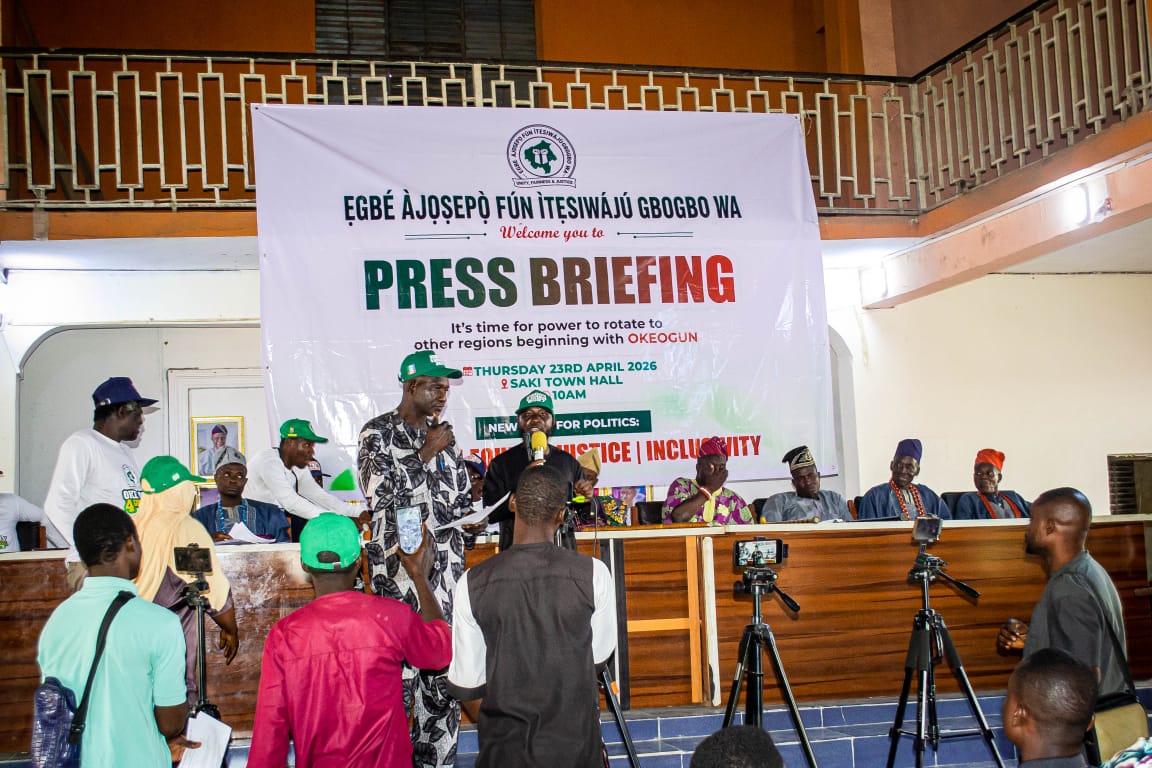
A socio-political advocacy group, Ẹgbẹ́ Àjọṣepọ̀ Fún Ìtẹsiwájú Gbogbo Wa, on Thursday called for the relocation of political power from Ibadan to the Òkèògùn axis of Oyo State ahead of the 2027 governorship election, citing decades of marginalisation and imbalance in the state’s leadership structure.
Addressing journalists at a press briefing held at Saki Town Hall in Saki, the National Chairman of the group, Engr. Dauda Olaifa, said the demand was rooted in “fairness, justice, equity, and inclusivity,” insisting that Òkèògùn had waited long enough for its turn to produce the state governor.
“For far too long, Oyo State has lagged behind in embracing rotational governance,” Olaifa said. “Since 1979, political power has remained disproportionately in the hands of one region for thirty-nine out of forty-seven years. This persistent imbalance contradicts not only moral principles but also the constitutional doctrine of Federal Character.”
He argued that the continued concentration of power in Ibadan and its environs had relegated other zones — including Òkèògùn, Ìbàràpá, Oyo, and Ogbómọ̀ṣọ́ to “secondary roles,” resulting in uneven development and a diminished sense of belonging among residents.
“The consequence is clear,” he added. “Our people have been systematically confined to the margins of governance. The time has come to correct this imbalance by allowing power to rotate ,beginning with Òkèògùn.”
The group also took issue with recent comments attributed to a prominent political figure, Sharafadeen Ali, who reportedly dismissed the viability of an Òkèògùn governorship bid. Olaifa described such remarks as “insensitive and unjustifiable.”
“After decades of waiting, any call for further delay is not only insensitive but unjustifiable,” he said. “If fairness cannot be accepted when reversed, it should not be imposed on others. Justice delayed, in this context, is justice denied.”
The group called on President Bola Ahmed Tinubu to support the emergence of a credible candidate from Òkèògùn, while also urging Oyo State Governor Seyi Makinde to align with what it described as a “just cause.”
It further appealed to the country’s major political parties, the All Progressives Congress (APC) and the Peoples Democratic Party (PDP), to zone their governorship tickets to the region in the spirit of equity.
“This moment represents a defining line beyond which we can no longer accept a subordinate role in determining our collective destiny,” Olaifa declared. “We are not asking for privilege; we are demanding fairness.”
He pointed to neighbouring Ogun State as an example of evolving political inclusivity, noting that its gradual adoption of rotational governance was expanding to include previously underrepresented regions.
Other speakers at the event stressed the need for cohesion among political leaders, traditional institutions, and grassroots stakeholders across the region to ensure the success of the agitation.
A community leader from the Òkèògùn axis, who spoke at the briefing, said unity would be critical in presenting a formidable front ahead of the 2027 elections. “This is not a struggle for one town or one interest group. “It is a collective aspiration that requires all sons and daughters of Òkèògùn to speak with one voice.”
Another speaker urged political actors to set aside personal ambitions in favour of the broader regional goal. “If we are divided, the dream will remain elusive.But if we stand together across party lines and interests, we can make history.”