
The Colonisation of Oyo State: Ibadan’s Iron Grip and the Case for Equity in 2027 (Part 1)
By Abimbola Adekunle
How 26 Years of Democratic Governance Have Locked Out Four of Five
Geopolitical Zones From the Highest Office in Oyo State
I. A Democracy of Unequals
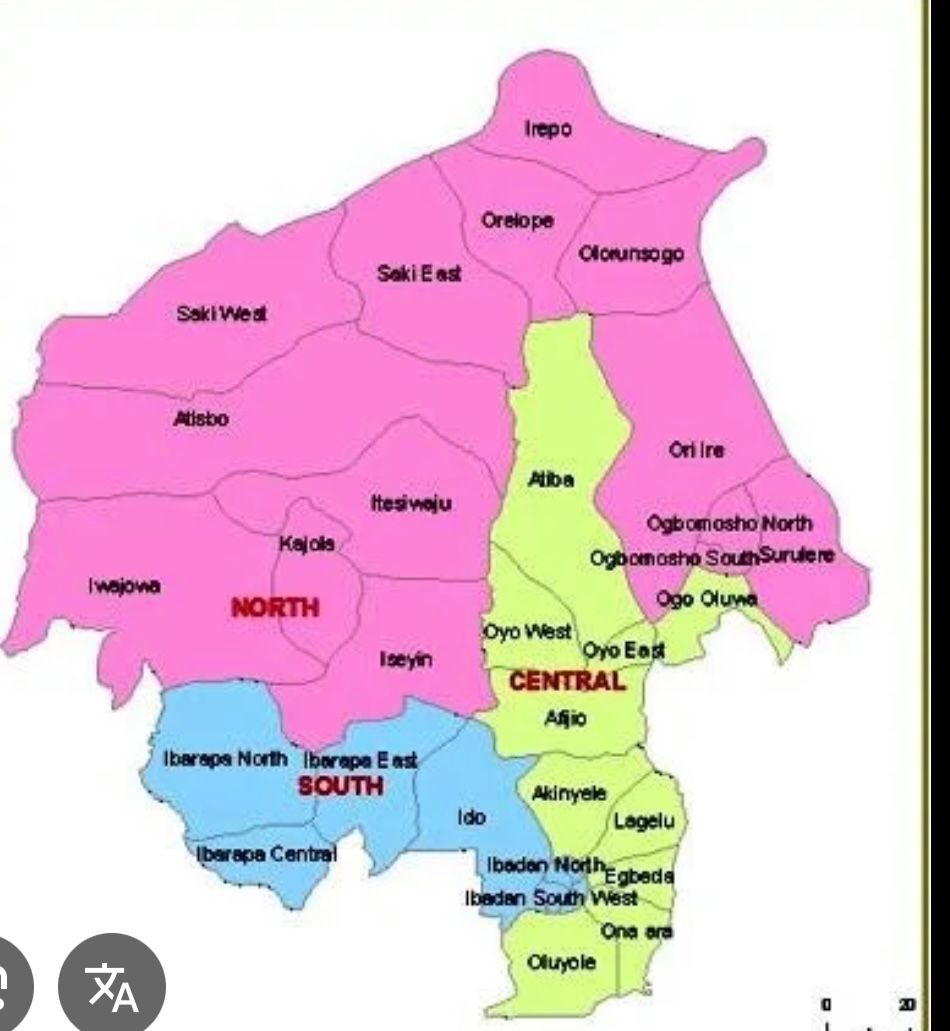
Oyo State was born in 1976 from the great sweep of Yoruba civilization, a state that carries within its borders five distinct geopolitical zones, each with its own history, culture, and political identity. There is Ibadan with its 11 local government areas, Oke-Ogun with 10, Ogbomoso with 5, Oyo with 4, and Ibarapa with 3. Together these zones house over seven million people. In theory, the governorship of Oyo State belongs to all of them. In practice, since the return of democracy in 1999, it has belonged almost exclusively to one.
An honest accounting of the numbers tells the story with uncomfortable clarity. Since 29 May 1999, Oyo State has been governed by an Ibadan indigene for approximately 23 of the 28 years of democratic rule, representing over 82 percent of the entire democratic era. The only interruption came from Ogbomoso, when the late Governor Christopher Adebayo Alao-Akala first assumed office through the political turbulence of Ladoja’s impeachment in January 2006 and subsequently won a full elected term in 2007, serving until 2011. That five-year Ogbomoso window is the sole exception in a quarter century of democracy. The Oyo zone has never produced a governor. Oke-Ogun has never produced a governor. Ibarapa has never produced a governor. These are not small footnotes. They are a constitutional question about the meaning of democratic representation.
Governor Tenure Origin Zone
1 Dr. Lam Adesina (AD) May 1999 – May 2003 Ibadan
2 Sen. Rashidi Ladoja (PDP) May 2003 – Jan 2006; Ibadan
Dec 2006 – May 2007
3 Gov. Adebayo Alao-Akala (PDP) Jan 2006 – Dec 2006 (acting);
May 2007 – May 2011 Ogbomoso
4 Sen. Abiola Ajimobi (ACN/APC) May 2011 – May 2019 Ibadan
5 Eng. Seyi Makinde (PDP) May 2019 – May 2027 (current) Ibadan
IBADAN TOTAL ~23 of 28 years of democracy 82.4%
NON-IBADAN TOTAL ~5 years (Ogbomoso only) 17.6%
Source: INEC records; Guardian Nigeria; The Sun Nigeria (compiled by the author).
II. The Oyo People: Warriors Who Have Never Been Subdued
To understand why this imbalance is not simply a political curiosity but a wound to pride and identity, one must understand who the Oyo people are. The ancient Oyo Empire, at the peak of its power in the seventeenth and eighteenth centuries, was one of the most formidable political and military structures in West Africa. Its cavalry was the terror of its enemies. Its administrative sophistication influenced statecraft across the sub-region. The Alaafin of Oyo commanded loyalty from peoples stretching across what is today Nigeria, Benin Republic, and Togo. The Yoruba word ‘Oyo’ evokes not merely a place but an idea: power, discipline, and an unbowed spirit.
History records that the Oyo people were among the most formidable warriors the Yoruba world produced. The Kakanfo title, the highest military honour in Yorubaland, was an Oyo institution. When the empire eventually declined under the weight of internal fractures and external pressure in the nineteenth century, the Oyo did not disappear. They regrouped, rebuilt, and endured. Their descendants today are citizens of Oyo State and they carry that heritage of resilience and self-determination in their political consciousness. A people with that history will not accept permanent political marginalization without consequence. And they should not be asked to.
Now look at the field of major candidates declared or anticipated for the 2027 Oyo State governorship election. The APC is expected to field Sharafa Abiodun Alli or Adebayo Adelabu, both Ibadan men. The APM is presenting Abimbola Adekambi, also from Ibadan. The Accord Party is putting forward Hamza Oriyomi or Fatal Owoseni, both from Ibadan. The PDP candidate is Hazim Gbolarumi, from Ibadan. And the ADC’s candidate is Chief Bisi Ilaka.
Four of the five major parties are fielding Ibadan indigenes. The party colours are different. The manifestos will differ. The campaign promises will vary. But on the fundamental question of which geopolitical zone produces Oyo State’s next governor, four of the five answers are the same: Ibadan again. This is not a coincidence. It is a pattern, and patterns in democracy eventually demand examination.
“If Ibadan takes this turn again, the 2031 governorship will mark 32 years since Oyo, Oke-Ogun, or Ibarapa last had reason to believe that the highest office in the state was also theirs to contest on equal terms.”
The late Governor Alao-Akala understood this dynamic. In his autobiography, Amazing Grace, he wrote with candour about the structural inequality that perpetually marginalises non-Ibadan indigenes in Oyo State politics. He was Ogbomoso, and it took the extraordinary circumstances of a controversial impeachment to first place him in Government House. When he won legitimately in 2007, it was the exception that proved the rule. Since he left in 2011, Ibadan has not relinquished the seat.
IV. Democracy Demands More Than Elections; It Demands Equity
Section 14(3) of Nigeria’s 1999 Constitution requires that the composition of government shall reflect the federal character of Nigeria and the need to promote national unity. This principle is not exclusive to the federal level. It is a value that should animate every tier of government. A state where one zone perpetually monopolizes the executive does not reflect the spirit of that constitutional mandate, whatever the electoral arithmetic.
Nigeria’s democracy has repeatedly wrestled with this question at the federal level through zoning arrangements for the presidency and vice presidency. Oyo State is not exempt from the same logic. When the Presidency rotates between north and south to preserve national cohesion, it is because Nigerians understand that elections alone do not produce legitimacy. Legitimacy also comes from the sense that power is shared, that all peoples see themselves in their government, that the state belongs to everyone within its borders and not only to those who have always held it.
The people of Oke-Ogun, the Oyo zone, and Ibarapa have waited long enough. They are not lesser citizens of Oyo State. Their taxes fund the same government. Their children attend the same schools that need fixing. Their roads are the same roads that need repair. They deserve a share of executive power not as a favour from Ibadan but as a matter of democratic right.
Abimbola Adekunle is a public commentator and political Affairs Analyst, writes from Ibadan, Oyo State.